

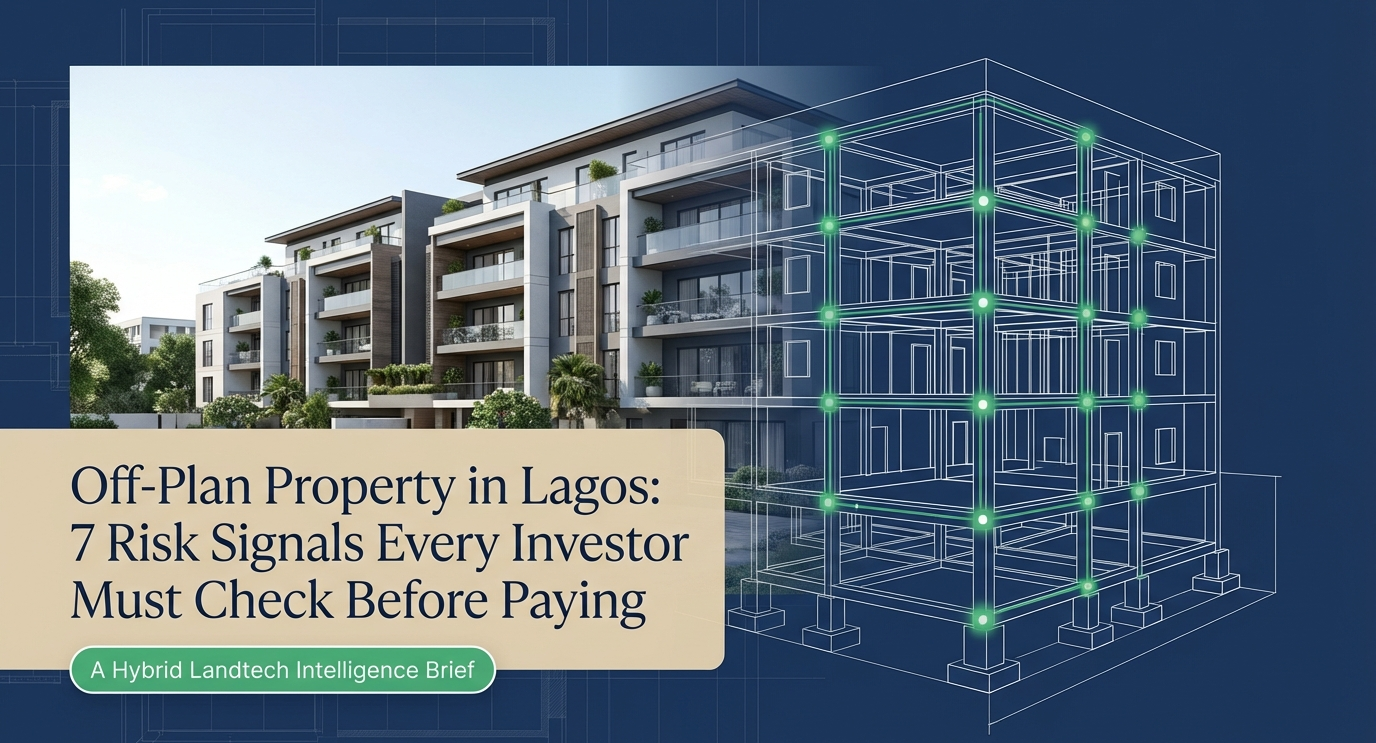
You did your research.
The renders looked excellent. The location made sense. The developer had a professional website, an active Instagram page, and glowing testimonials from other investors. Everything checked out, at least on the surface.
So you paid maybe ₦10,000,000 or ₦20,000,000
Six months in, the updates went quiet. A site visit revealed a concrete slab and a security guard who had not been paid in three months. The developer’s phone still worked, but the answers kept changing.
By the time you found a property solicitor, the company had quietly been wound down.
Variations of this story play out regularly in the Lagos off-plan property market. And in most cases, the investor had no idea there were specific signals every investor must check before transferring a single naira for an off-plan property.
We’ll show you seven of them…
| WHY THESE SIGNALS MATTER The Lagos real estate market has regulatory layers that most investors outside the industry never see. LASPPPA approvals, C-of-O file verification, COREN-registered engineering oversight, these are not formalities. They are the paper trail that separates a legally compliant project from one that can be work-stopped, demolished, or abandoned without legal consequence to the developer. The checks below draw on the specific documentation that legitimate Lagos developers produce as a matter of course. If a project cannot produce these documents, that is not a paperwork delay. It is a signal. |
| NOTE This article contains general information and not legal advice. Consult a qualified Nigerian property solicitor for any specific transaction. |
Risk Signal 1: No Verifiable Certificate of Occupancy (C-of-O)
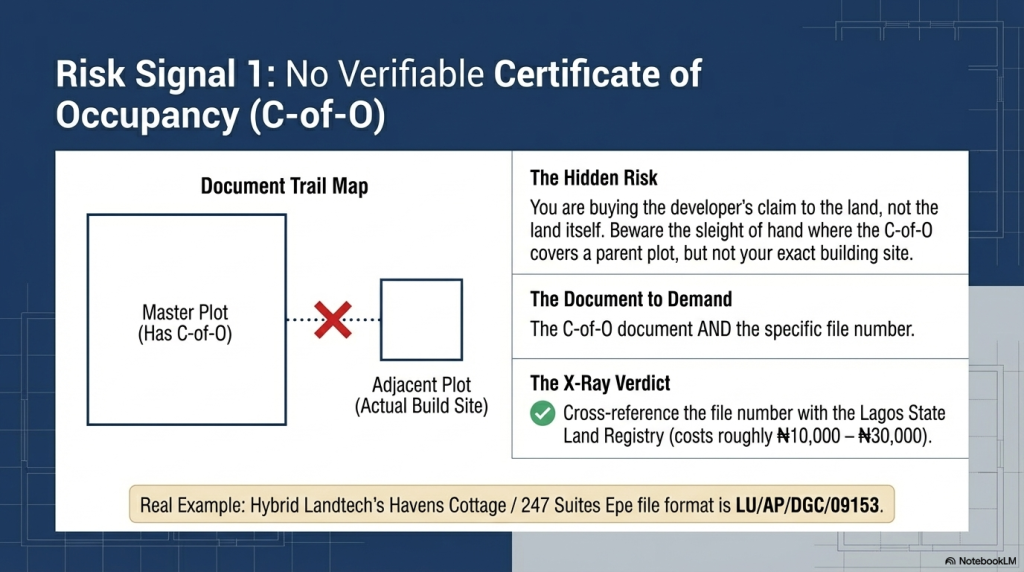
A Certificate of Occupancy is the Lagos State government’s formal recognition of the right to occupy a specific parcel of land. Without it, you are buying the developer’s claim to land, not the land itself.
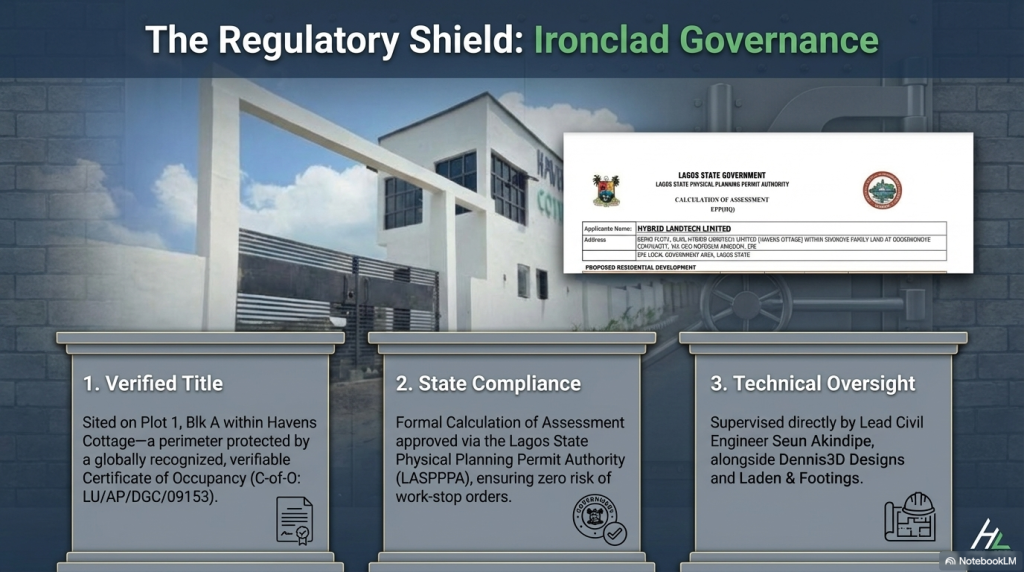
What to ask for: the C-of-O document and the file number. Lagos C-of-O file numbers follow a specific format, for example, LU/AP/DGC/09153, which belongs to Hybrid Landtech’s Havens Cottage where 247 Suites Epe is also sited.
You can cross-reference the title number with the Lagos State Land Registry for a fee of roughly ₦10,000 – ₦30,000.
Also confirm that the C-of-O covers the exact plot where the development sits, not just an adjacent or parent plot. That distinction matters enormously in compound estate developments, and it is a common sleight of hand.
Risk Signal 2: No LASPPPA Approval Permit or Active Application
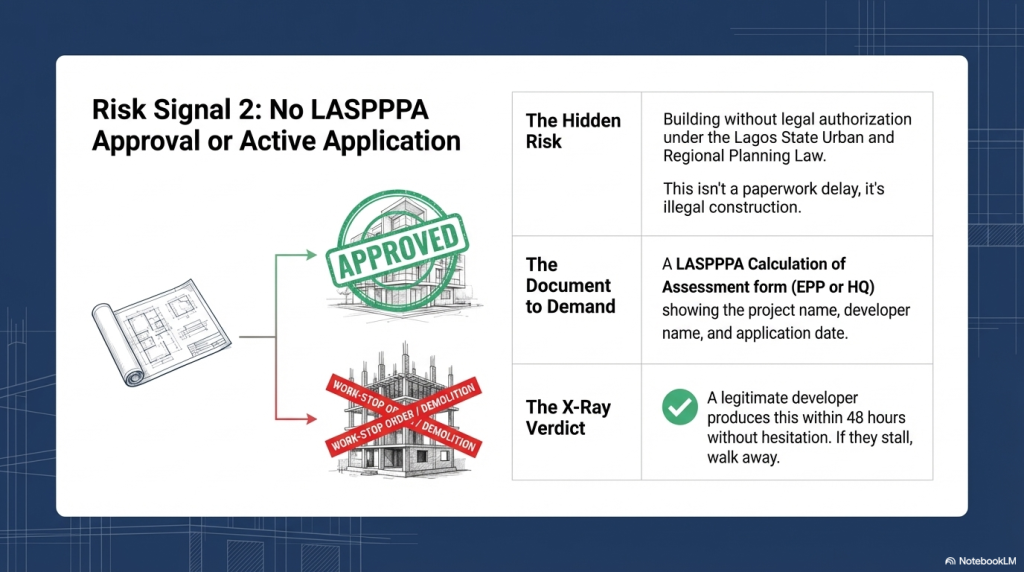
The Lagos State Physical Planning Permit Authority (LASPPPA) approves building plans and construction activity across Lagos State.
Any developer building without an active LASPPPA permit, or at minimum a documented application in progress, is building without legal authorisation.
Illegal constructions in Lagos are subject to work-stop orders and demolition, as set out under the Lagos State Urban and Regional Planning Law.
According to Estate Intel, regulatory compliance failure is among the top three causes of project abandonment in Lagos.
The document to request: a LASPPPA Calculation of Assessment form (EPP or HQ, depending on the LGA) showing the project name, developer name, and application date. A legitimate developer produces this without hesitation. If they stall, that is your answer.
Risk Signal 3: No Named Structural Engineer on Record
Beautiful architectural renders cost at minimum ₦200,000 to produce. A COREN-registered structural engineer willing to put their name and licence number on a building costs significantly more, and is worth every naira.
What to ask for: the name and COREN registration number of the structural and civil engineering firms attached to the project. Then verify the registration directly at coren.gov.ng.
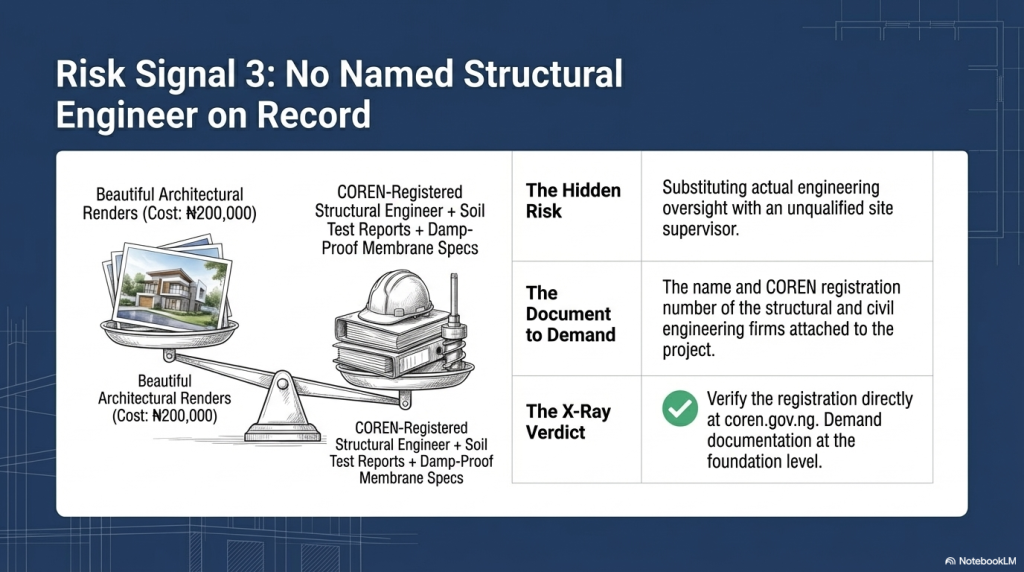
Beyond credentials, look for engineering oversight at foundation level: soil test reports, pad foundation specifications, and damp-proof membrane (DPM) installation documentation. These are standard outputs on any competently managed project.
If the developer can only offer the name of a “site supervisor” with no formal engineering affiliation, treat that as a red flag.
As a point of note, the engineering of the off-plan project 247 Suites is being undertaken by Laden and Footings Nigeria Ltd. This detail has been made accessible in the project’s technical brief for verifiability and transparency.
Risk Signal 4: No Fixed-Price Material Commitment
Nigeria’s construction cost environment is volatile. Cement, structural steel, and imported MEP equipment can increase 20 to 40 per cent year-on-year during a naira-depreciation cycle.
Developers who have not locked in long-lead material costs before construction begins are building on a floating budget. When costs overshoot, there are three possible outcomes.
- The developer absorbs the overrun, unlikely unless they are well-capitalised.
- They pass the overrun to investors through a cost adjustment clause buried in the contract.
- Or they slow and ultimately halt construction while seeking more funds.
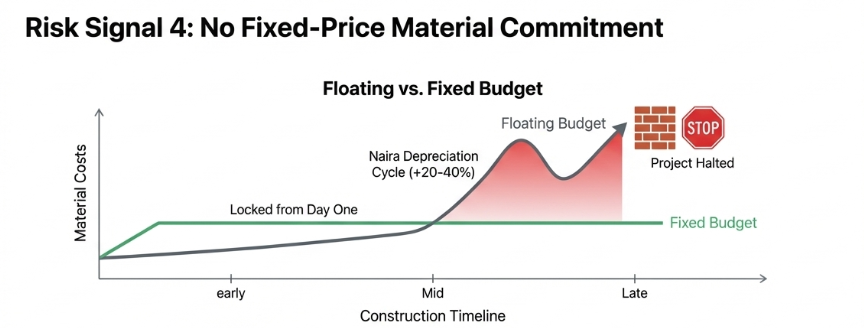
What to ask directly: what percentage of long-lead materials, structural steel, roofing, MEP equipment, have been price-locked or procured? Credible developers lock in 60 to 70 per cent before breaking ground. This is a structural protection for your investment timeline and projected ROI.
Risk Signal 5: No Delivered Projects You Can Visit
Every developer has a portfolio page. Very few have completed, occupied, and still-standing developments that you can physically walk through and assess.
Before committing capital: request the physical addresses of at least two previously completed projects. Visit them. Check occupancy levels, finishing quality, and whether the infrastructure, power, water, security, actually functions in practice.
A developer who has delivered an estate, sold it out, and moved to the next project has a fundamentally different risk profile from one whose only evidence is construction photographs and promotional videos.
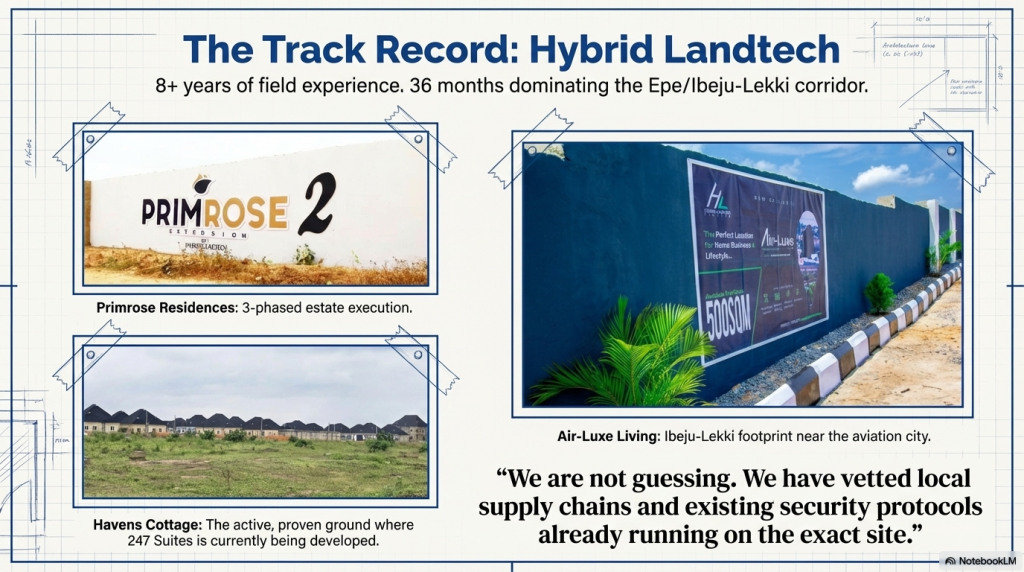
You can explore Hybrid Landtech’s completed track record, including Primrose Residences in Ota and Gidi Town Ikola on the Lagos mainland on the website and our social media platforms.
Risk Signal 6: No Investor Reporting Infrastructure
Once you have paid, how do you verify the project is progressing?
Legitimate developers have a defined reporting cadence: monthly construction updates with dated photographs, milestone notifications tied to the payment schedule, and a named project manager you can actually reach between visits.
For income-generating assets specifically, reporting extends beyond construction. Post-completion, you should have access to a real-time dashboard showing occupancy rates, booking data, and monthly income distributions.
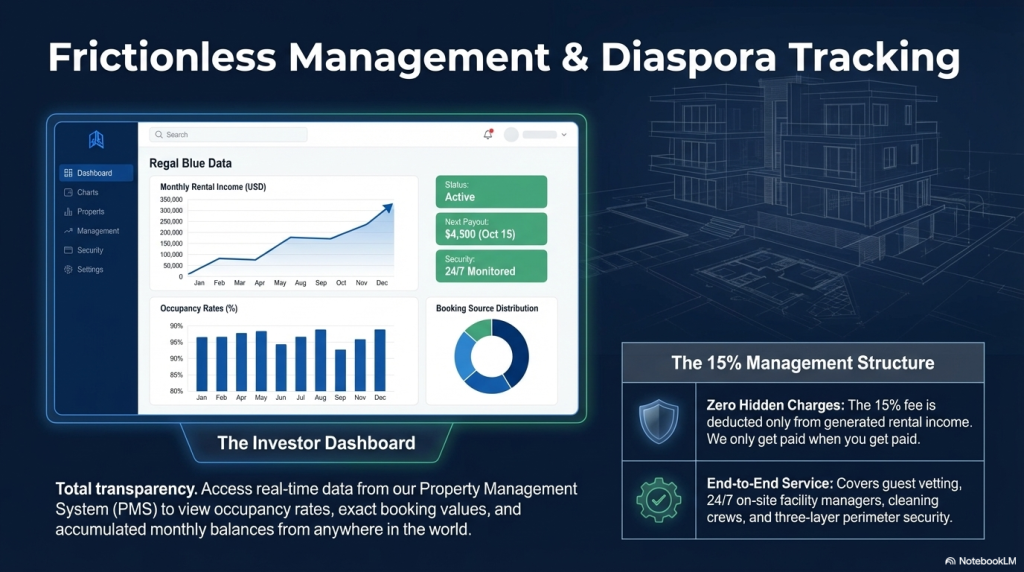
If a developer cannot describe this system before you sign, that is a governance gap, not a minor admin detail.
This matters especially for diaspora investors. If you cannot monitor your investment remotely, you are entirely dependent on trust. That is a fragile position to be in.
Risk Signal 7: The Contract Has No Default or Refund Clause
The subscription agreement is your only legal protection if the project stalls.
Most investors sign whatever they are given. Most should not.
A well-structured agreement includes:
- A construction milestone schedule tied to payment tranches
- A developer default definition, typically six months behind schedule
- A refund mechanism specifying return of capital in the event of default
- A dispute resolution clause naming a specific arbitration body or process
If the contract you receive does not contain these provisions, have a Nigerian property solicitor review and redline it before you sign. That review typically costs ₦50,000 – ₦150,000. On a ₦21M commitment, it is non-negotiable.
The Quick-Reference Checklist Before You Transfer Anything
Run through these seven points for any off-plan investment in Lagos:
| Signal | What to Ask For | Green Flag | Red Flag |
|---|---|---|---|
| C-of-O | File number + Land Registry check (₦10k–15k) | Verifiable file number on exact plot | No file number or “in process” |
| LASPPPA Approval | Calculation of Assessment document | Active application with project name on record | Cannot produce within 48 hours |
| Structural Engineer | COREN registration number | Registered firm with signed appointment | Only a “site supervisor” named |
| Fixed-Price Procurement | % of long-lead materials price-locked | 60–70%+ locked before groundbreaking | Open market procurement throughout |
| Track Record | Physical addresses of 2 completed projects | Occupied, standing, visitable | Only renders and site photos available |
| Reporting Infrastructure | Cadence, format, and dashboard access | Monthly updates + live investor dashboard | No defined reporting process |
| Contract Clauses | Default definition + refund mechanism | Milestone schedule + clear exit on default | No default clause; no refund provision |
Off-plan property investment in Lagos is not inherently risky. Going in without this checklist is.
If you are evaluating a development in the Epe corridor right now, the 247 Suites Epe technical brief and the Havens Cottage product page are structured to address every one of these seven signals, with documentation, not just promises.
For broader context on what makes a serviced apartment investment worth committing to, our guide on how serviced apartment investments work in Nigeria and our breakdown of real estate passive income strategies for 2026
are useful reading before you make any final decisions.
Ready to Put Your Money to Work?
Explore the full 247 Suites Epe investment opportunity, 247 Suites Epe product page, or browse all Hybrid Landtech projects in Our Products at the top of the screen here.
Download the Technical Brief | Investment Brochure
Speak to us directly:
- MD: +234 703 1028 401
- Sales: 0916 333 1487 | 0916 247 9433
- Email: hybridlandtech@gmail.com
