

Here is a question worth sitting with.
You have ₦21,000,000 sitting in a Nigerian savings account. Over twelve months, at a headline savings rate of 4 to 6 per cent, you earn roughly ₦840,000 – ₦1,260,000 in interest.
Meanwhile, Nigeria’s year-on-year inflation has been running above 28 per cent, according to the National Bureau of Statistics. Your money is not growing. It is shrinking, quietly, month after month, even as the balance stays the same.
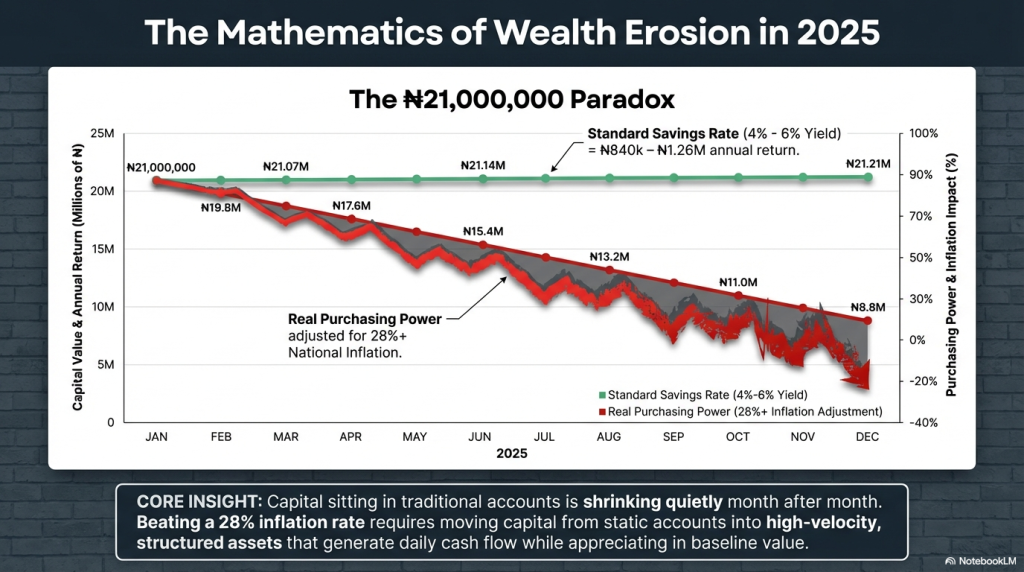
This is the reality for millions of Nigerians with savings right now. And the people outrunning it share one habit: they move their money into assets that generate real income.
Real estate is the most accessible of those assets. But the gap between real estate passive income in Nigeria that actually works and real estate that just sits and waits is enormous.
Here is an honest look at five strategies in play in 2026, and where the returns are sharpest.
| A NOTE ON WHAT “PASSIVE” ACTUALLY MEANS IN NIGERIA In theory, passive income means money arriving without daily effort. In practice, a lot of Nigerian real estate income is anything but passive. Long-term landlords spend weekends dealing with broken water pumps. They chase rent annually. They absorb vacancy gaps of three to six months between tenants. True passivity comes from professional management infrastructure, an operator who handles bookings, maintenance, and income distribution, and gives you a dashboard to verify all of it. Keep that distinction in mind as you read through the five options below. |
Option 1: Land Banking — High Appreciation, Zero Monthly Income
Land banking is the most talked-about strategy in Nigerian real estate circles.
Buy an undeveloped plot in a rising corridor, Ibeju-Lekki, Ota, Epe, Mowe-Ofada, hold it for several years, and sell at a significant premium. Real estate products like Greenville 2 and Primrose Residences work best for this strategy.
It works. Plots in parts of Ibeju-Lekki that cost under ₦1M a decade ago are now valued at ₦8M – ₦15M. The appreciation is real and well-documented.
But here is the honest limitation.
Land banking is a capital gains strategy, not an income strategy. The land earns you nothing while you hold it.
- No monthly payments.
- No cash flow.
- No return until you exit, which typically means a five to fifteen-year horizon.
If you need your capital to pay you while it grows, land banking is not the right vehicle on its own.
Option 2: Standard Buy-to-Let — Familiar, but Often Disappointing
Buying a residential property and renting it long-term is the classic income play. In Lagos, a ₦20M property in an emerging estate can generate ₦1.2M – ₦2.0M per year in rent. That is a gross yield of 6 to 10 per cent, better than a savings account.
But the real picture is more complicated.
Nigerian tenants typically pay one or two years upfront, meaning your cash flow is lumpy rather than monthly.
Vacancy gaps of three to six months between tenants are standard.
Maintenance in the first few years of a new property often absorbs 15 to 25 per cent of gross rent. And when a tenant stops paying, enforcement is a personal exercise.
Buy-to-let works. But it is rarely as passive as the pitch makes it sound.
Option 3: Commercial Property – Strong Yields, High Entry Barrier
Office space, retail units, and warehouse bays in well-located Lagos corridors can yield 8 to 12 per cent annually.
Commercial leases are typically more enforceable than residential ones, and lease terms are longer.
The challenge for most investors is the entry price. Anything meaningful in a well-located area starts at ₦50M and above. And concentration risk is real.
If your anchor tenant vacates, your income can drop to zero overnight.
For investors working within a ₦15M – ₦30M budget, commercial property is rarely a realistic starting point.
Option 4: Real Estate Investment Trusts (REITs) — Liquid, but Low Control
REITs let you invest in income-generating property through the Nigerian Stock Exchange without buying a physical asset.
Nigeria’s REIT market, including UPDC REIT and SFS Real Estate Investment Trust, offers dividend yields of roughly 5 to 8 per cent.
The advantages are clear: low minimum investment, liquidity, no management burden. You can buy and sell your position the way you would a stock.
The trade-off: you own a share of a fund portfolio, not a specific titled asset. Your returns depend on fund manager decisions as much as underlying property performance. Dividends are discretionary, not contractual.
REITs are a useful diversification tool. But for investors looking to build a meaningful monthly income stream from Nigerian real estate, they work better as a complement to direct ownership, not a substitute for it.
Option 5: Managed Hospitality Studio Ownership, The Highest-Yield Combination Right Now
This is the model outperforming everything else on this list for investors in the ₦15M – ₦30M range.
A managed hospitality studio like 247 Suites Epe combines the direct asset ownership of buy-to-let with hotel-level revenue velocity and the operational passivity of a REIT. Here is what the conservative numbers look like on a studio unit in the Epe corridor:
| Metric | Projection |
|---|---|
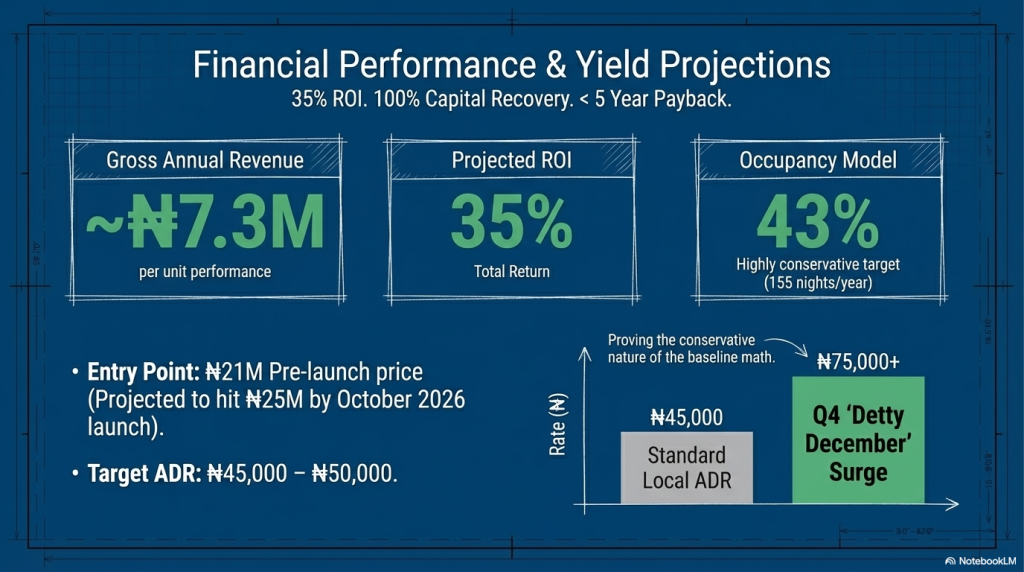
| Entry price | ₦21,000,000 |
| Target ADR | ₦45,000 – ₦50,000 per night |
| Annual occupancy (conservative) | 43%, approx. 157 nights per year |
| Gross annual revenue | ₦7.0M – ₦7.9M per unit |
| Net monthly income (after 15% mgmt fee) | ₦350,000 – ₦550,000 |
| Target ROI | 35% total return + full capital recovery |
That is three to four times the monthly income of a standard buy-to-let at the same ₦21M entry price.
Why the numbers work
The driver is demand layering. A well-sited studio near a major industrial hub, a cluster of universities, and a seasonal event circuit has three independent booking streams running simultaneously. When one is quiet, the others carry it.
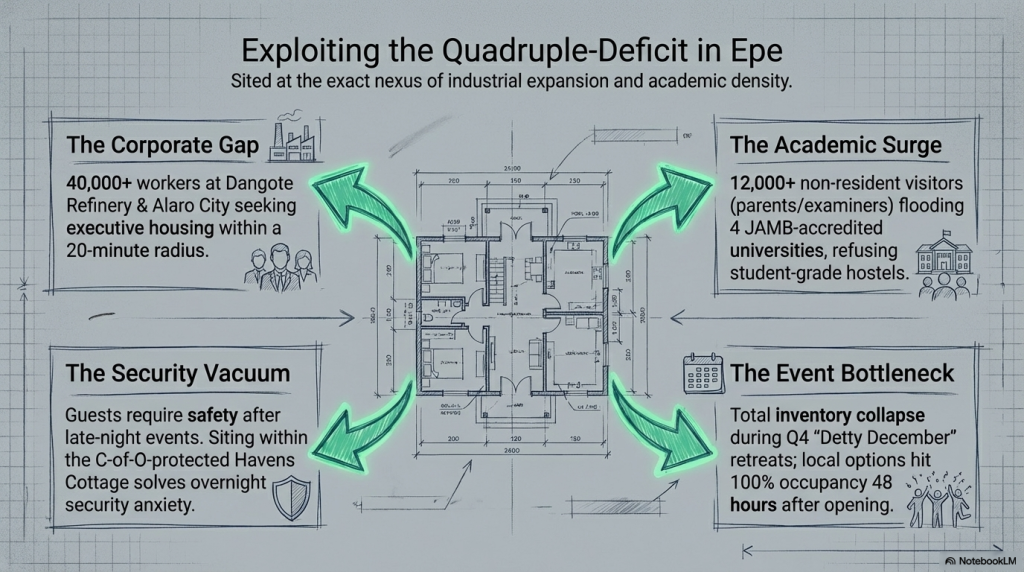
The Epe corridor specifically sits at the intersection of the Lekki-Epe industrial spine, home to the Dangote Refinery, Alaro City, and Lekki Port, and an academic belt with four JAMB-accredited universities. Add the Detty December influx, and you have year-round demand from three completely different audiences.
During peak periods like the JAMB examination window or December, rates run at 1.5 to 2x standard pricing, pushing ADR well above the ₦50,000 baseline.
What makes it truly passive
The investor owns a titled, registrable unit, not a fund share. Capital appreciation runs alongside monthly income. The operator handles bookings, guest vetting, cleaning, maintenance, and monthly income distributions.
A real-time investor dashboard means you can check your occupancy rate and earnings from anywhere, including the diaspora, without setting foot in Lagos.
If you want to see this model with full specifications and yield projections, the 247 Suites Epe product page has the complete breakdown, including the engineering brief and a downloadable investment brochure.
You can also explore the Havens Cottage estate, the C-of-O protected perimeter where 247 Suites is sited.
The Honest Summary: Which Option Is Right for You?
Here is a straight comparison across all five strategies:
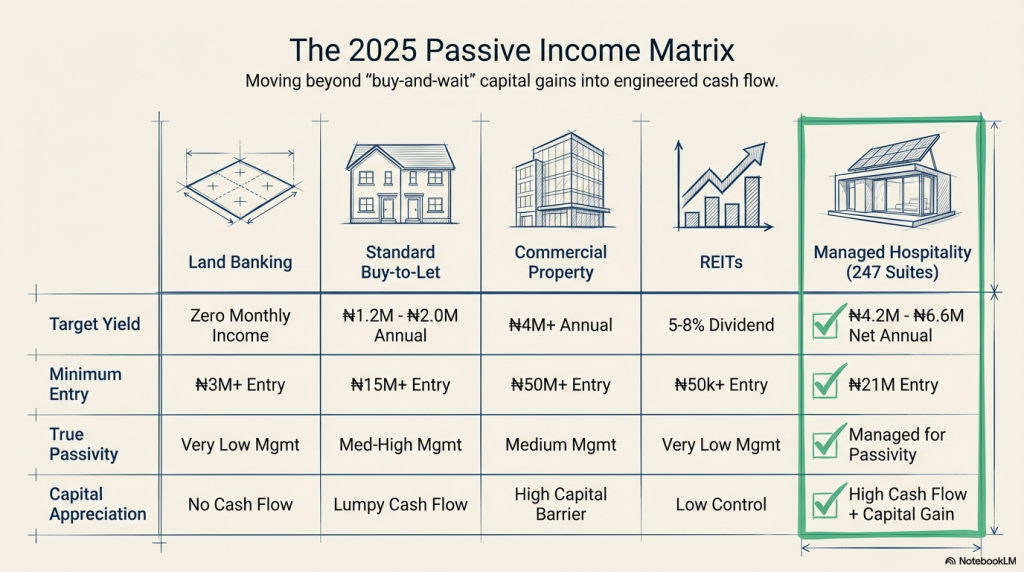
| Option | Annual Income | Entry Point | Management Burden | True Passivity |
|---|---|---|---|---|
| Land Banking | Zero (capital gain only) | ₦3M+ | Very Low | High, but no income |
| Buy-to-Let | ₦1.2M – ₦2.0M | ₦15M+ | Medium–High | Low |
| Commercial Property | ₦4M+ | ₦50M+ | Medium | Medium |
| REITs | 5–8% dividend | ₦50,000+ | Very Low | High |
| Managed Hospitality Studio | ₦4.2M – ₦6.6M | ₦21M | Very Low (managed) | High |
If your goal is capital appreciation over fifteen years, land banking in a rising corridor still makes sense. If your goal is meaningful monthly income from a titled asset you own outright, with a professional operator running it on your behalf, the managed hospitality studio is the clearest path at this price range in 2026.
For a deeper look at how to stress-test any specific investment opportunity before you commit, read our guide on off-plan property risks in Lagos. And if you want to understand the management model in detail, our breakdown of how serviced apartment investments work in Nigeria covers the mechanics and returns data thoroughly.
Ready to Put Your Money to Work?
Explore the full 247 Suites Epe investment opportunity, 247 Suites Epe product page, or browse all Hybrid Landtech projects in Our Products at the top of the screen here.
Download the Technical Brief | Investment Brochure
Speak to us directly:
- MD: +234 703 1028 401
- Sales: 0916 333 1487 | 0916 247 9433
- Email: hybridlandtech@gmail.com
